


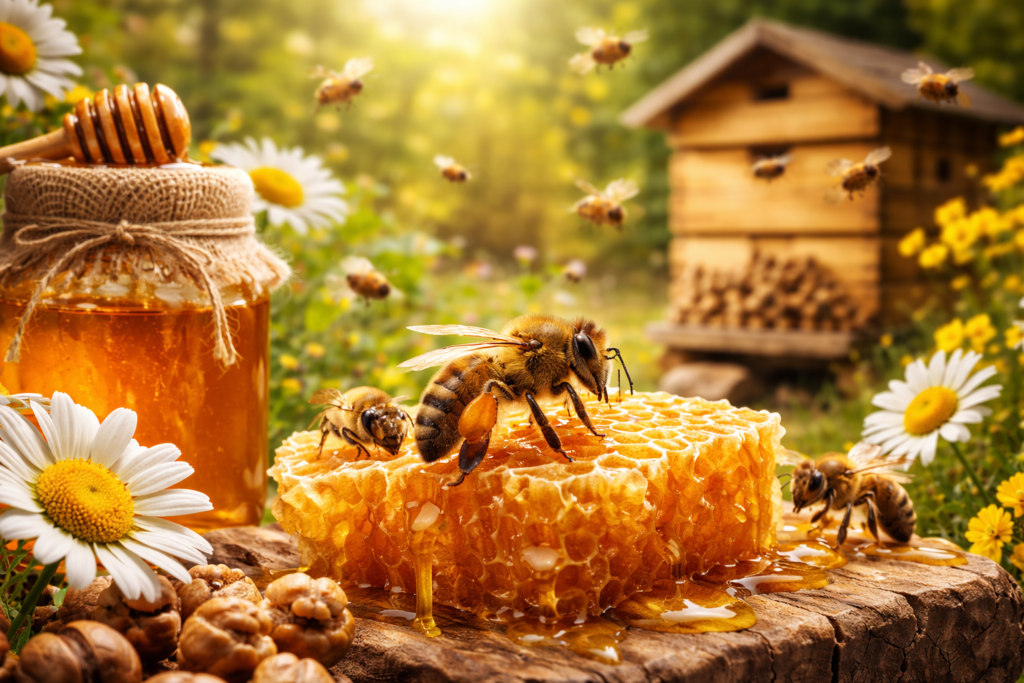
How bees make honey
Honey is one of nature’s most precious gifts—but have you ever wondered how it is made? Behind every drop of golden honey lies an incredible story of hard work, teamwork, and natural intelligence. From flying across fields to carefully storing nectar, bees follow a fascinating process to create this sweet treasure.
Let’s explore how bees turn flower nectar into pure, delicious honey.
Step 1: Collecting Nectar from Flowers
The journey of honey begins in blooming flowers.
Worker bees fly from flower to flower in search of nectar. Using their long, tube-like tongues, they suck nectar and store it in a special pouch called the “honey stomach.” This pouch is different from their regular stomach and is used only for carrying nectar.
During this process, bees also collect pollen and help pollinate plants, supporting nature’s life cycle.
Step 2: Mixing Nectar with Natural Enzymes
As nectar is stored in the honey stomach, it begins to change.
Inside the bee’s body, natural enzymes mix with the nectar. These enzymes break down complex sugars into simpler ones, making the nectar easier to digest and helping it transform into honey later.
This is the first step in turning watery nectar into thick, nutritious honey.
Step 3: Passing Nectar Inside the Hive
Once the worker bee returns to the hive, it passes the nectar to another worker bee.
This process is called “regurgitation” (passing nectar mouth-tomouth). Each bee adds more enzymes to the nectar, improving its
quality and thickness.
The nectar is passed between several bees before it is ready to be stored.
Step 4: Storing Nectar in Honeycomb Cells
After processing, the nectar is placed into tiny hexagon-shaped cells of the honeycomb.
These cells are made from beeswax produced by the bees themselves. The honeycomb acts as a natural storage system for
honey, pollen, and baby bees.
At this stage, the nectar is still watery and needs further drying.
Step 5: Removing Excess Moisture
Fresh nectar contains a lot of water—sometimes up to 70–80%. To turn it into honey, bees must reduce this moisture.
Worker bees fan their wings rapidly over the honeycomb. This creates airflow inside the hive and helps evaporate extra water from
the nectar.
As the moisture decreases, the nectar becomes thicker and turns into real honey.
Step 6: Sealing the Honey with Beeswax
When the honey reaches the right thickness, bees seal each cell with a thin layer of beeswax.
This wax cover protects the honey from air, moisture, and bacteria. It keeps the honey fresh for months or even years.
Sealed honey serves as food for bees during winter and times when flowers are scarce.